
1-Month-Old Baby: Settling In
Having your baby at home with you in the first few weeks might have felt overwhelming. As the weeks progress and you gradually adjust to this new little person in your life, you might soon be feeling more confident and comfortable. Don’t get too comfortable though! Newborns develop and change rapidly, and your baby will be keeping you on your toes in weeks five, six, seven, and eight. To help you feel more prepared we’ll outline some typical milestones for a 1-month-old baby, cover what you need to know about feeding and sleeping at this stage, and give you a heads-up on potential issues you might face, like colic and cradle cap.

Baby Development Milestones
Your baby is unique (you knew that, of course!) and it’s normal for her to grow at her own pace. Don’t be surprised if your baby’s development in one area seems to lag for a few weeks, only for her to catch up soon after. Here are some of the baby milestones to look forward to now that your baby is 1 month old.
Growth and Physical Development: Chubby Cheeks
Does it seem as if your baby’s growing out of her clothes at supersonic speed? On average, babies gain about 1 to 1 ½ inches in length and about 1 ½ to 2 pounds in weight this month. At the upcoming health checkup, your healthcare provider will look at your 1-month-old baby’s weight, length, and head circumference and plot these key measurements on baby growth charts. What matters is that your baby grows at a steady rate. Having said that, your baby will go through growth spurts from time to time.
You might notice that your baby’s head is disproportionately larger than her body. This is perfectly normal: her head’s growing a little faster and her body will soon catch up. Your baby will also start to lengthen and develop stronger muscles. Luckily, she’ll still have those cute chubby cheeks for some time to come!
Senses: Eyes on That Rattle
In every waking moment, your baby is slowly taking in the sights, sounds, and smells around her. This month, your baby may be able to better focus on faces and objects, and may soon start to track them with her eyes as they move in front of her. In the next month or so she may also start to reach for objects. For example, if you hold a rattle in front of her she may start batting at it.
Movement: Working on Those Leg Muscles
This month, your baby’s movements will mostly still be reflexive, but some of the reflexes present in the baby growth charts may gradually start to disappear and be replaced by more controlled movement. When she’s on her tummy she may briefly hold her head up, and she may start to stretch her arms out more instead of holding them close to her body. She may also start to stretch and kick her legs out. It might seem like a little thing but she’s actually working hard to strengthen her leg muscles. Keep in mind: Even very young babies can roll over from time to time, so make sure you keep an eye — and hand — on her when she’s up somewhere high like a changing table.
Crying and Communication: Mom, I'm Bored (or Hungry)!
This month your baby can probably start communicating in a clearer way. For example, if she’s bored she may let you know by crying out until she’s shown something new. If she’s amused, she may respond by smiling. Around this time, you might also start being able to tell the difference between her hungry cries, tired cries, and irritated cries. If you haven’t experienced it yet, this month you might see her first true smile, sometime called the social smile. She'll flash that little grin when she's awake, in response to something like the sound of your voice — and your heart will melt.
How to Support Your Baby’s Development
Here are some things you could try this month:
Playing with your baby is a great way to support essential growth and development, but keep in mind that there’s only so much new information young babies can take in. Watch for signs that your baby has had enough — she might look away or cry — and give her a chance to rest.


Baby Growth Chart Calculator
Keep an eye on your baby’s height, weight, and head circumference to average growth with our simple tool.
This is a mandatory field.
This is a mandatory field.
This is a mandatory field.
This is a mandatory field.
*Input details of your baby’s last measurements **Source: World Health Organization
Feeding Your 1-Month-Old Baby
You may be wondering how much to feed your 1-month-old baby as she grows. Continue to feed your baby whenever she seems hungry. At this age, that’s probably about eight times in a 24-hour period for breastfed babies or about every three to four hours for bottle-fed babies. If your baby is mid-growth spurt she may want to eat a little more often.
If you’re breastfeeding, check out our go-to guide to discover essential breastfeeding basics.
Burping Your Baby
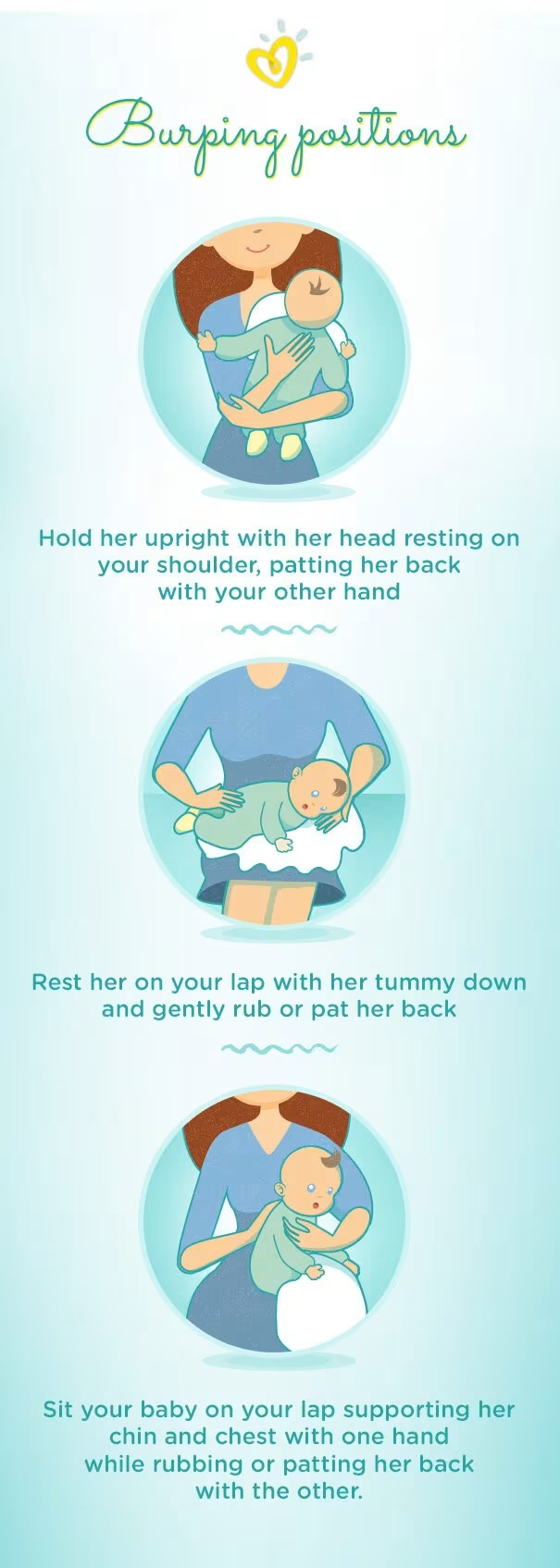
Babies can swallow air when they feed — more often when they’re bottle-fed than when nursing. This swallowed air can make them feel uncomfortable and fussy. To help, burp your baby during bottle feeds, or when you switch her from one breast to the other. Make sure you have a burp cloth or a small blanket covering your clothes to guard against spit-up milk or formula, and try one of these burping positions and techniques:
Tracking wet and dirty diapers: At this stage, babies may produce about four to six wet diapers a day. When it comes to poopy diapers, there is a wide range of what’s “normal.” Most babies will have at least one bowel movement a day, but some babies may go several days or a week without pooping. This is likely totally OK so long as the consistency of the stool is normal — in other words soft and a little runny — and your 1-month-old baby is eating well and gaining weight. Consult your baby’s healthcare provider if you’re concerned you might be seeing too few diapers.
Given all the diapering going on, keep in mind that your baby’s fragile skin needs soft, comfortable diapers — such as Pampers Swaddlers. Watch this short video about Pampers Swaddlers for sensitive skin. Download the Pampers Rewards app and you can even turn diapers and wipes into rewards and discounts.

How Much Sleep Does a 1-Month-Old Baby Need?
At this age babies sleep about 14 to 17 hours a day — including about five naps during the day. With some luck, your baby might start to sleep for longer stretches at night from about 6 weeks of age. You might be feeling super tired, but there is light at the end of the tunnel: Over time, your baby’s sleep cycle will slowly get closer to yours. Of course, eventually, your baby will develop a bedtime routine and her biological sleeping rhythms will emerge, but for now it’s important to allow your baby to sleep whenever she’s drowsy. This is when she’ll get the best quality sleep. Always put your baby to sleep on her back.
If your baby cries when you put her down, soothe her by rocking her, playing relaxing music, or talking to her softly. Feel free to pick her up for a few minutes and return her to the crib when she seems calm again. Read why your baby might wake up at night for more on this topic.

A Day in the Life of Your Baby
Early Hygiene Habits
Perhaps you’re already a pro at bathtime, but if you still need some inspiration, check out our video on how to make baby bathtime fun for your newborn.

Your Baby’s Health: When Is Crying Colic?
All babies cry from time to time, but crying may be a condition called colic if
Your healthcare provider may make a diagnosis of colic if your little one cries for more than three hours a day, more than three days a week, for at least three weeks straight. Colic often starts when a baby is 2 to 4 weeks old and can last until the baby is about 3 to 4 months old.
Experts aren't sure about the cause of colic, but some potential factors could include:
Although colic usually only lasts a few months, this can seem like a lifetime when your baby is in the middle of a crying spell! Sometimes, nothing will seem to work to calm him and your nerves may fray. Never shake your baby. Instead, leave him safely in his crib for a short time and take a break in another room, or ask a loved one to care for him for a few hours so you can have some much-deserved “me time.” With colic, there is light at the end of the tunnel; in a few months or so those colicky crying spells will likely come to an end.
Other health issues to know about include:
Regular Health Visits and Immunizations
Regular checkups at this early stage typically take place when your baby turns 1 month old and again when he’s 2 months old. Of course, you can call your baby’s healthcare provider any time you have a question or concern, even between visits. At your baby’s regular checkups your baby’s provider will

FAQs at a Glance
If you are breastfeeding, wait until your baby is at least 1 month old to offer a pacifier. Keep in mind, it’s best to offer a pacifier after or between feeds, so as not to disrupt mealtimes. Use of a pacifier when going to sleep may help reduce the risk of SIDS. Your baby may like the pacifier as sucking can be soothing for him, but if he doesn’t want it, don’t force it.

Your Life as a Parent: A Problem Shared Is a Problem Halved
You might be feeling more confident this month as some of the uncertainty you may have felt during the first few weeks starts to fade away. Still, talk about any concerns you have with trusted loved ones or your healthcare provider. A problem shared is a problem halved, and you might be surprised how much better you feel afterward.
If you're breastfeeding, you might experience discomfort resulting from a breast infection called mastitis. Contact your healthcare provider if you notice symptoms such as sore breasts, fever, or nausea. Don’t stop nursing as this will make things worse. Keep in mind that it’s safe for your baby to nurse when you have mastitis — the milk is not infected. Treatment for mastitis includes expressing milk from your breasts either by feeding or pumping, but your provider may also recommend antibiotics. Get plenty of rest and drink lots of water to help your body fight the infection. Here’s more about what mastitis is and how to treat it.
Checklist for This Month
How we wrote this article
The information in this article is based on the expert advice found in trusted medical and government sources, such as the American Academy of Pediatrics and the American College of Obstetricians and Gynecologists.
The content on this page should not replace professional medical advice. Always consult medical professionals for full diagnosis and treatment.
1 month old baby - checklist

- KidsHealth: Your Baby’s Hearing, Vision & Other Senses: 1 Month
- KidsHealth: Your Baby’s Hearing, Vision & Other Senses: 2 Months
- KidsHealth: Your Child’s Development: 2 Months
- KidsHealth: Your Baby’s Growth: 1 Month
- KidsHealth: Your Baby’s Growth: 2 Months
- KidsHealth: Your Child’s Checkup: 1 Month
- KidsHealth: Your Child’s Checkup: 2 Months
- KidsHealth: Learning, Play, and Your 1- to 3-Month-Old
- KidsHealth: Sleep and Your 1- to 3-Month-Old
- KidsHealth: Learning, Play, and Your Newborn
- KidsHealth: Movement, Coordination, and Your 1- to 3-Month-Old
- KidsHealth: Your Colicky Baby
- KidsHealth: Feeding Your 1- to 3-Month-Old
- KidsHealth: Medical Care and Your 1- to 3-Month-Old
- KidsHealth: Communication and Your 1- to 3-Month-Old
- Healthy Children: Emotional and Social Development: Birth to 3 Months
- Healthy Children: Pooping By the Numbers
- Book: Caring for Your Baby and Young Child, 6th Edition: Birth to Age 5 Paperback - November 4, 2014
by American Academy Of Pediatrics (Author)

Newborn Baby: The First 4 Weeks
Congratulations! You have a newborn baby. Find out what you need to know about your newborn- to 1-month-old baby’s sleeping and feeding routines, physical development, and more.
Read more
3-Month-Old Baby: Getting into a Groove
Your 3-month-old baby’s muscles and bones continue to develop. He or she may go longer between feeds. Find more typical 3-month-old baby milestones here.
Read more
2-Month-Old Baby: Happiness and Comfort in Familiar Faces
Your 2-month-old baby may be feeding six to eight times a day. Find out how your baby is developing, sleeping, and reaching exciting milestones this month.
Read moreNewborn Baby: The First 4 Weeks
Congratulations! You have a newborn baby. Find out what you need to know about your newborn- to 1-month-old baby’s sleeping and feeding routines, physical development, and more.
Read more3-Month-Old Baby: Getting into a Groove
Your 3-month-old baby’s muscles and bones continue to develop. He or she may go longer between feeds. Find more typical 3-month-old baby milestones here.
Read more2-Month-Old Baby: Happiness and Comfort in Familiar Faces
Your 2-month-old baby may be feeding six to eight times a day. Find out how your baby is developing, sleeping, and reaching exciting milestones this month.
Read moreNewborn Baby: The First 4 Weeks
Congratulations! You have a newborn baby. Find out what you need to know about your newborn- to 1-month-old baby’s sleeping and feeding routines, physical development, and more.
Read more3-Month-Old Baby: Getting into a Groove
Your 3-month-old baby’s muscles and bones continue to develop. He or she may go longer between feeds. Find more typical 3-month-old baby milestones here.
Read more2-Month-Old Baby: Happiness and Comfort in Familiar Faces
Your 2-month-old baby may be feeding six to eight times a day. Find out how your baby is developing, sleeping, and reaching exciting milestones this month.
Read more