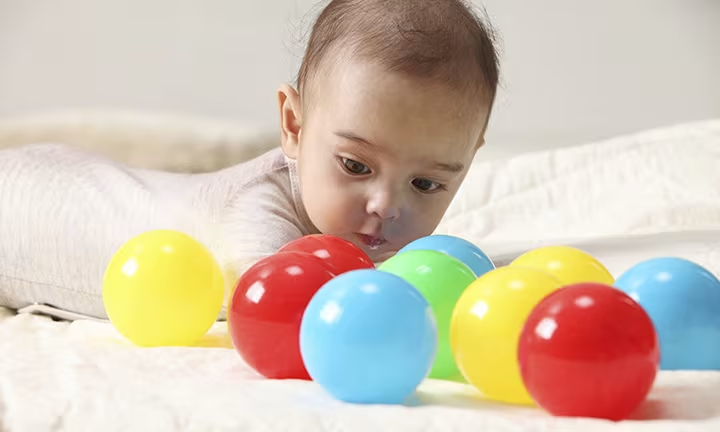
Object Permanence in Babies



As your baby grows physically, she’s also advancing mentally, gaining knowledge and understanding of how the world around her works. One of the cognitive skills your baby will develop in her first year is understanding the concept of object permanence. Learn what exactly object permanence is and how you can help foster your baby’s grasp on it. Hint: get ready to play lots of peek-a-boo!
What Is Object Permanence?
Object permanence is the concept that objects continue to exist even when they’re not in sight. Early on, babies don’t yet have the cognitive skills to understand that what they can’t see still exists. For young infants, the world around them contains only what they can see in front of them at any given moment. For example, if you were to leave your baby’s room, he may assume you’ve vanished into thin air. The same goes for concealing objects, such as when you cover a toy with a blanket. He will think the toy has disappeared forever. In time, your baby will begin to understand that you still exist even if she can’t see you, and that a hidden toy is still there under the blanket.
At What Age do Babies Start to Grasp Object Permanence?
Your baby will begin to understand the concept of object permanence when he is around 7 or 8 months old. You can tell that your baby is beginning to understand object permanence if he starts looking around for a toy you've just hidden. Separation anxiety usually starts soon after. That’s when your baby may "cling" to you and fuss or cry when you leave his sight or go away. With separation anxiety, your baby most likely will be in distress when you leave the room because she doesn’t know that you’ll come back. Once she understands the concept of object permanence, she’ll know that she can expect your return, and she may cry a little less, or not at all, while you’re away.
Stages of Object Permanence
Your little genius will go through a few stages as she develops more cognitive awareness, especially around object permanence.
How Can You Help Your Baby Learn the Concept of Object Permanence?
Object permanence is a natural part of your baby’s cognitive development, and you can help foster this aspect by playing games and enjoying certain activities like peek-a-boo and hide-and-seek, or by hiding and revealing objects. When your baby first starts to understand object permanence around 7 or 8 months old, try this simple game:
As your baby observes all the things that happen in the household, such as the comings and goings of siblings, parents, and pets, the concept of object permanence will slowly become more and more reinforced.
Is Peek-a-Boo an Example of Object Permanence?
Peek-a-boo is actually a great example of a game that can help your baby understand the concept of object permanence. You could also play other similar games with your baby. For example, during diapering hide your face with your hands, and then reveal your smiling face.
The Bottom Line
Seeing your baby grow and develop is a wonderful thing. There’s so much for your little one to learn about the world and it’s incredible to watch your baby’s horizons expanding at breakneck speed! The concept of object permanence is just one of the many important things your baby is learning in her first year, and it’s something you can easily help encourage with a little fun! Try playing hide-and-seek with a favourite toy or peek-a-boo to help encourage your baby’s development. In time, your baby will learn that the toy hasn’t disappeared for good, and that mommy and daddy will always return.
The information in this article is based on the expert advice found in trusted medical and government sources, such as the American Academy of Pediatrics and the American College of Obstetricians and Gynecologists. You can find a full list of sources used for this article below. The content on this page should not replace professional medical advice. Always consult medical professionals for full diagnosis and treatment.
Baby Growth Spurts: When Do They Typically Occur?
When do babies have growth spurts? Discover baby growth spurts, including signs, timing, and tips for supporting your little one during these growth phases.
Read more
What Are Gross Motor Skills?
Gross motor skills are a huge milestone in your little one’s development. Read on to learn more about what they are and when to expect them.
Read more
What Are Fine Motor Skills?
What are fine motor skills? Learn how toddlers develop fine motor skills and get better at performing intricate tasks with their hands.
Read more
Understanding and Managing Separation Anxiety in Babies
Learn to recognize and address separation anxiety in babies, including symptoms, causes, and soothing techniques.
Read more
When Do Babies Start Crawling?
Many babies start crawling between 7 and 10 months. Find out if your child is showing early signs of crawling and learn more about this developmental milestone.
Read more
When Do Babies Sit Up?
Find out at what age your baby might sit up on their own, signs they’re about to reach this milestone, and how to help your baby learn to sit up.
Read more
Moro Reflex Explained
What is the Moro reflex? Read more about this involuntary startle reflex to learn why it occurs in newborns in their first few months and how long it lasts.
Read moreBaby Growth Spurts: When Do They Typically Occur?
When do babies have growth spurts? Discover baby growth spurts, including signs, timing, and tips for supporting your little one during these growth phases.
Read moreWhat Are Gross Motor Skills?
Gross motor skills are a huge milestone in your little one’s development. Read on to learn more about what they are and when to expect them.
Read moreWhat Are Fine Motor Skills?
What are fine motor skills? Learn how toddlers develop fine motor skills and get better at performing intricate tasks with their hands.
Read moreUnderstanding and Managing Separation Anxiety in Babies
Learn to recognize and address separation anxiety in babies, including symptoms, causes, and soothing techniques.
Read moreWhen Do Babies Start Crawling?
Many babies start crawling between 7 and 10 months. Find out if your child is showing early signs of crawling and learn more about this developmental milestone.
Read moreWhen Do Babies Sit Up?
Find out at what age your baby might sit up on their own, signs they’re about to reach this milestone, and how to help your baby learn to sit up.
Read moreMoro Reflex Explained
What is the Moro reflex? Read more about this involuntary startle reflex to learn why it occurs in newborns in their first few months and how long it lasts.
Read moreBaby Growth Spurts: When Do They Typically Occur?
When do babies have growth spurts? Discover baby growth spurts, including signs, timing, and tips for supporting your little one during these growth phases.
Read moreJoin Pampers Club and get:
- PAMPERS COUPONS
- TOOLS & QUIZZES
- PARENTING TIPS
 PAMPERS COUPONS
 TOOLS & QUIZZES
 PARENTING TIPS