
Signs of Labour: Early Signs Labour Is Approaching


How does labour start? Is it when your water breaks? Is it when you feel contractions? Those are both sure signs that you’re in labour, but, sometimes, those initial and early signs of labour are more subtle. Rest assured your body almost always gives you the signals you need and the inner wisdom to recognize them. Learn about the stages of labour, the differences between true and false labour, the signs and symptoms of both early and active labour, and what to do when you think it’s baby time!
What Is Labour?
Labour, more commonly called childbirth, is the experience of delivering your baby from the warm and cozy home of your uterus to the outside world. You’ve probably been excitedly and anxiously awaiting this moment for quite some time, but it’s important to understand that labour is a slow, multistep process that’s unique for each pregnancy. That said, labour tends to follow a general pattern for most people. Knowing about what’s likely to happen can help you prepare for the big day ahead.
RELATED PREGNANCY TOOL

Baby Name Generator
Filter by gender:
Filter by theme:
When Does Labour Start?
Although your due date is usually calculated according to the average length of pregnancy, which is 40 weeks for a full-term pregnancy, don’t expect your baby to arrive on the dot. It’s not uncommon for labour to start before or after your due date!
Labour may begin earlier than 40 weeks, such as at week 38 or 39. However, going into labour before 37 weeks of pregnancy is called preterm labour. This sometimes stops on its own without leading to preterm birth but will always need immediate medical attention.
On the other hand, a pregnancy can last between 41 and 42 weeks, which is referred to as late term, and even last longer than 42 weeks, which is called post term. If your due date has come and gone, you may be eager for labour to begin. You might have heard of traditional methods of inducing labour, such as drinking castor oil, which has not shown to be effective. In fact, experts don’t recommend trying any kind of home remedy! So, if you’re concerned labour hasn’t started yet, the best thing to do is consult your healthcare provider.
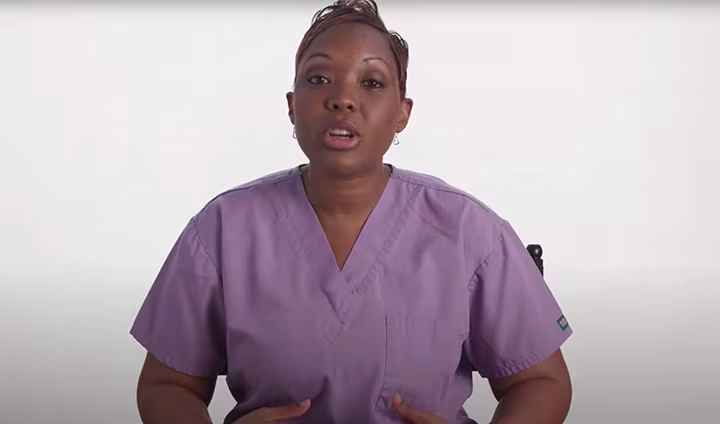
Stages of Labour
Childbirth is broken down into three stages:
Signs and Symptoms of Labour
Is nausea a sign of labour, or maybe headaches or diarrhea? Labour is a different experience for every person and can vary from pregnancy to pregnancy, but there are some similarities, too. It helps to recognize what’s common but always consult your healthcare provider with questions or if you experience any other symptoms.
Here are the 10 most common signs of labour:
Learn more about these signs and symptoms of labour in the following two sections, which cover the two phases (early and active labour) in stage one.
Signs and Symptoms of Early Labour
Signs of early labour can be unpredictable in terms of duration. It may be hours or even days before you progress to active labour, especially if this is your first baby. (This time will usually become shorter with subsequent deliveries.) Until your contractions become more regular and more intense, or your water breaks, try to stay relaxed—active labour will eventually start.
Although every pregnancy is different, you may experience the following signs of early labour, some more subtle than others:
Signs and Symptoms of Active Labour
Active labour is when things really start to happen—and when you should head to the hospital. Active labour can last from four to eight hours, and sometimes even longer. By this time, your cervix may likely be dilated from 6 to 10 centimetres, and you will notice stronger signs and symptoms that you’re in labour:
True Labour Vs. False Labour
Sometimes you may feel as if you’re going into labour, but it’s not real labour. So, how can you tell the difference between the signs of true and false labour (known as Braxton Hicks contractions)? A tried-and-true method of telling the difference is by timing the contractions and making note of whether the contractions go away when you move.
Use the table below to help distinguish between true and false labour:
| True Labour | False Labour |
|---|---|
| Contractions are regular and follow a predictable pattern (such as every 8 minutes). | Contractions are irregular and unpredictable, occurring, for example, in intervals of 10 minutes, then 6 minutes, 2 minutes, 8 minutes, etc. |
| You experience three types of progression: contractions become more frequent, longer lasting, and stronger. | No progression is seen over time in the closeness of the contraction intervals, length, or strength of the contractions. |
| Each contraction is felt starting at the lower back, radiating around to the front, low in the groin. | Contractions are felt in the front. |
| A change in activity or position won’t slow or stop contractions. | A change in activity or position may cause contractions to slow or stop. |
| Your healthcare provider will notice your cervix softening, thinning, or dilating. | No cervical changes occur. |
What to Do When You Notice Signs of Early Labour Coming
In the early stages, with only a few signs of labour, you may not need to go to the hospital just yet. Labour can take a lot of time, and you’ll may be more comfortable and perfectly safe staying at home. If at any point you’re concerned about what you’re experiencing, contact your healthcare provider. Realizing you’re in labour can bring feelings ranging from excitement to disbelief or apprehension. Try to stay calm and focused. Arrange to have your partner or friend with you to help record labour symptoms, keep you company, and get you to the hospital when the time comes. You can also try to ease any discomfort by

When to Call Your Healthcare Provider and Go to the Hospital
If you’ve noticed the signs of early or active labour but have any doubt about whether it’s really happening, call your healthcare provider for advice. However, be sure to call your healthcare provider or go to the hospital if you’re experiencing any of these signs:

FAQS AT A GLANCE
Signs of early labour may indicate that labour is coming or has begun. These signs can include:
- Nesting, which is a sudden burst of energy to get everything ready before your baby arrives.
- Lightening, when your baby drops lower into your pelvis, relieving some pressure from your diaphragm.
- Mild contractions that you may feel in your back and abdomen that happen 5 to 15 minutes apart and last for between 60 and 90 seconds.
- Effacement, when your cervix thins, softens, and shortens.
- Dilation, when your cervix begins to open.
- Loss of your mucus plug, which you’ll notice as a thick, pinkish or blood-streaked vaginal discharge.
The Bottom Line
As your due date approaches, keep an eye out for the early signs and symptoms of labour and have your birth plan ready. It’s very unlikely that you will suddenly go into labour without warning—your body will likely let you know that you’re close to the big day! Knowing you’re prepared will help reduce anxiety when you notice those first signs of labour, whether at 37 weeks, 38 weeks or earlier or later. You’re nearing the end of your pregnancy, and you’re about to bring your baby into the world. You can do this! In the meantime, relieve anxiety by stocking up on diapers to get rewards with the Pampers Club app.
- Book: Your Pregnancy and Childbirth: Month to Month, Sixth Edition Paperback – January 1, 2016, by American College of Obstetricians and Gynecologists (Author)
- March of Dimes: Stages of labor
- ACOG: When pregnancy goes past your due date
- Mayo Clinic: Preterm labor
- ACOG: Preterm labor and birth
- Mayo Clinic: Inducing labor
- Kids Health: Inductions
- Mayo Clinic: Signs of labor
- ACOG: How to tell when labor begins
- March of Dimes: Amniotic fluid
- Mayo Clinic: Bleeding during pregnancy
- Mayo Clinic: Preeclampsia

Breech Presentation: What It Is and How It Can Affect Your Baby's Delivery
A breech baby is a baby that has not yet turned head down in your uterus before being born. Read about the causes and what can be done to encourage your baby to turn.
Read more
Diastasis Recti: Abdominal Separation in Pregnancy
What is diastasis recti (abdominal separation) during pregnancy or after childbirth? Learn the causes, signs, and treatment options.
Read more
Episiotomy: Definition, Healing Process, and When It's Needed
Learn about episiotomy, why it might be needed, and how long episiotomy healing takes. Understand the differences between a natural tear and an episiotomy.
Read more
What is Cervical Effacement?
You might have heard of the term effacement before, but you may be unsure of its meaning. Learn all you need to know about cervical effacement and dilation.
Read more
Mucus Plug During Pregnancy: What It Is and When Do You Lose It?
Discover the mucus plug’s role in pregnancy, when it typically discharges, and how long after losing it labor generally begins. Understand this key milestone.
Read more
What are Braxton Hicks Contractions?
Understand Braxton Hicks contractions, their causes, and how to differentiate them from true labour contractions during your pregnancy journey.
Read more
What Is an Epidural?
Find out what an epidural is, how it functions, and when to consider getting one during labour. Understand the benefits and possible side effects.
Read more
All About Inducing Labour
Learn about the methods of labor induction, why they’re done, and what to expect during the process. Get prepared with insights for your birthing journey.
Read more
FAQ: Postpartum Hair Loss
Many new moms suffer from hair loss after giving birth. Learn how long postpartum hair loss usually lasts and how you can try to prevent the shedding.
Read more
Everything You Need to Know About the Apgar Score
Learn about the Apgar Score, its purpose in assessing newborn health immediately after birth, and what each part of the score means for you and your baby.
Read moreBreech Presentation: What It Is and How It Can Affect Your Baby's Delivery
A breech baby is a baby that has not yet turned head down in your uterus before being born. Read about the causes and what can be done to encourage your baby to turn.
Read moreDiastasis Recti: Abdominal Separation in Pregnancy
What is diastasis recti (abdominal separation) during pregnancy or after childbirth? Learn the causes, signs, and treatment options.
Read moreEpisiotomy: Definition, Healing Process, and When It's Needed
Learn about episiotomy, why it might be needed, and how long episiotomy healing takes. Understand the differences between a natural tear and an episiotomy.
Read moreWhat is Cervical Effacement?
You might have heard of the term effacement before, but you may be unsure of its meaning. Learn all you need to know about cervical effacement and dilation.
Read moreMucus Plug During Pregnancy: What It Is and When Do You Lose It?
Discover the mucus plug’s role in pregnancy, when it typically discharges, and how long after losing it labor generally begins. Understand this key milestone.
Read moreWhat are Braxton Hicks Contractions?
Understand Braxton Hicks contractions, their causes, and how to differentiate them from true labour contractions during your pregnancy journey.
Read moreWhat Is an Epidural?
Find out what an epidural is, how it functions, and when to consider getting one during labour. Understand the benefits and possible side effects.
Read moreAll About Inducing Labour
Learn about the methods of labor induction, why they’re done, and what to expect during the process. Get prepared with insights for your birthing journey.
Read moreJoin Pampers Club and get:
- PAMPERS COUPONS
- TOOLS & QUIZZES
- PARENTING TIPS
 PAMPERS COUPONS
 TOOLS & QUIZZES
 PARENTING TIPS