
23 Weeks Pregnant
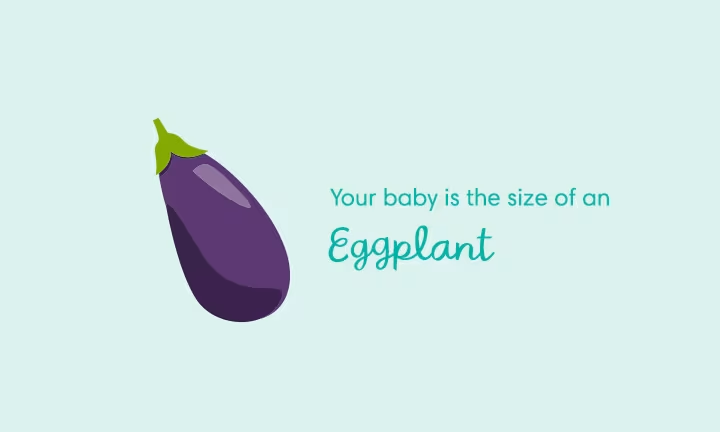
Your baby is the size of an
Being 23 weeks pregnant can be an exciting time filled with new experiences and changes as your baby continues to grow and develop. You may be starting to feel more movement as your baby becomes more active inside your belly. Keep reading to explore the symptoms you may experience during 23 weeks pregnant and some tips to help you stay healthy and comfortable. Whether you are a first-time parent or a seasoned pro, we hope you’ll find this information valuable and supportive as you navigate this incredible journey.
Highlights at 23 Weeks Pregnant
Before we get into all the details about 23 weeks pregnant, here are some of the highlights:
Remember, weight gain is natural at this stage as your baby grows and your uterus expands. Your healthcare provider can offer diet and exercise tips to help you stay on track. If you want to keep track of your weight gain at 23 weeks, use our Pregnancy Weight Gain Calculator below:
Pregnancy Weight Gain Calculator
Fill out your details:
23 Weeks Pregnant: Your Baby's Development
What’s happening with your baby at 23 weeks pregnant? Here are some of the exciting developments:
If you’re 23 weeks pregnant with twins, take a look at our twin or multiples pregnancy guide to find out more about your symptoms and how they differ from a single pregnancy!
How Many Months Is 23 Weeks Pregnant?
What is 23 weeks pregnant in months? You may have heard your pregnancy being referred to in weeks and wonder how that translates into months. There are various methods of grouping the 40 weeks of pregnancy into months, and at 23 weeks, you’re likely in your sixth month and your second trimester.
Baby’s Size at 23 Weeks Pregnant
What fruit or vegetable size is your baby at 23 weeks pregnant? Your little one is now about the size of an eggplant. They probably weigh around 450 grams and measure about 28 centimetres in length.
Your Baby: What Does 23 Weeks Pregnant Look Like?
The illustration below can give you an idea of what a baby looks like and how they’re developing inside the uterus around 23 weeks:

Your Body at 23 Weeks Pregnant
You may have gained about 10 to 15 pounds of baby weight by the time you’re 23 weeks pregnant. At 23 weeks and at any time during your pregnancy, you can always check in with your healthcare provider to make sure that your pregnancy weight gain is healthy and appropriate for your situation.
You might like to also read up on pregnancy weight gain facts and advice.
If your provider determines that you're gaining too much weight or not enough weight, they can offer individual advice to help you stay on track. For example, if you’re gaining too much pregnancy weight at 23 weeks, your provider may recommend adjusting your diet and exercising more.
Gaining a healthy amount of weight during pregnancy will make it easier to slowly lose those extra pounds after you’ve given birth.
At 23 weeks pregnant, you can probably feel your baby’s movement, although some parents-to-be may need to wait a little while longer.
At some point in the next few months, your healthcare provider may ask you to monitor your baby’s movements by doing a set of “kick counts” each day. To do this, you would choose a time of day when your baby is usually active and keep track of how long it takes to count 10 movements that your baby makes.
Give your provider a call if more than 2 hours pass before feeling these 10 movements; you notice decreased fetal movement at 23 weeks; or you detect any overall changes in your baby’s movement. You may find this downloadable pregnancy guide, containing a fetal movement tracker, helpful.
23 Weeks Pregnant: Your Symptoms
Here are a few of the symptoms you may be experiencing at 23 weeks pregnant. But remember, every pregnancy is unique.
How Big Is a Pregnant Belly at 23 Weeks?
Now that you’re 23 weeks pregnant, the size of your belly bump may be more and more obvious. After 20 weeks, your healthcare provider may start measuring your fundal height (distance from your pubic bone to the top of your uterus). Now and in the following weeks, your fundal height in centimetres may be roughly the same as the number of weeks you’re pregnant—around 23 centimetres at 23 weeks, for example—give or take 2 centimetres.
What Does 23 Weeks Pregnant Look Like?
For a general idea of the size of your uterus and belly bump this month, when you're around 23 weeks pregnant, check out the image below.

23 Weeks Pregnant: Things to Consider
From eating well to picking out baby names, you may have a lot going on at 23 weeks pregnant. Here are a few things to consider during this period:
Tip for Partners Your little one may be responsive to familiar sounds now, including your voice. Try talking or singing to them every day. This may create special bonding moments between you, your baby, and your pregnant partner. You may even be lucky enough to feel some tiny movements and kicks in response. |
23 Weeks Pregnant: Questions for Your Healthcare Provider
Here are some common questions you might want to ask your healthcare provider at 23 weeks pregnant:
FAQS AT A GLANCE
Although you can group the 40 weeks of pregnancy into months using various methods, at 23 weeks you’re generally considered 6 months pregnant.
23 Weeks Pregnant: Your Checklist
You can use our helpful checklist for some guidance during this period:
□ Enjoy looking back on memories? Why not consider organizing a maternity photo shoot while you still have the energy? You could hire a professional photographer or ask a friend who you know takes lovely pictures. You could do the photo shoot in a beautiful outdoor spot, or in your baby’s nursery, if it’s ready. Plus, you could have individual shots and some shots with your partner or loved ones.
□ If you have time this week, read this article on pregnancy warning signs not to ignore. It's always wise to prepare and know what to look out for.
□ Wondering how prepared you are for your baby’s arrival? Take this baby arrival quiz to find out! No matter the result—don’t worry—you still have plenty of time to get everything prepared.
23 weeks pregnant - checklist
How We Wrote This Article The information in this article is based on the expert advice found in trusted medical and government sources, such as the American Academy of Pediatrics and the American College of Obstetricians and Gynecologists. You can find a full list of sources used for this article below. The content on this page should not replace professional medical advice. Always consult medical professionals for full diagnosis and treatment.
- American College of Obstetricians and Gynecologists. Your Pregnancy and Childbirth: Month to Month, 6th ed. (Washington, DC: American College of Obstetricians and Gynecologists, 2015).
- American College of Obstetricians and Gynecologists. Your Pregnancy and Childbirth: Month to Month, 7th ed. (Washington, DC: American College of Obstetricians and Gynecologists, 2021).
- Mayo Clinic. Guide to a Healthy Pregnancy, 2nd ed. (Rochester, MN: Mayo Clinic Press, 2018).
- Cleveland Clinic. “ Fetal Development Stages of Growth.”
- Cleveland Clinic. “Fundal Height.”
13 Weeks Pregnant
At 13 weeks, your baby's organs are fully formed and hard at work, but there’s still lots more growing to do. Find out what else is happening this week.
Read more
11 Weeks Pregnant
At 11 weeks pregnant, you’re nearing the end of the first trimester. Discover what pregnancy symptoms are common around this time, and when they may subside.
Read more
4 Weeks Pregnant
At 4 weeks pregnant, implantation occurs, and the embryo is about the size of a poppy seed. Learn more about being 4 weeks pregnant.
Read more
10 Weeks Pregnant
At 10 weeks pregnant, discover how your baby’s developing and learn about the symptoms you might experience this week.
Read more
1, 2, and 3 Weeks Pregnant
Educate yourself on the very early signs of pregnancy, spanning from 1 to 3 weeks, with detailed insights. Understanding what to expect in those crucial time.
Read more
38 Weeks Pregnant
At 38 weeks, your pregnancy is almost full term. Given most babies aren’t born on their due dates, you could meet your little one any day now. Learn more here.
Read more
5 Weeks Pregnant
At 5 weeks pregnant, the placenta and umbilical cord are forming. Discover some of the most common pregnancy symptoms at 5 weeks.
Read more
20 Weeks Pregnant
Did you know that at 20 weeks, in addition to moving and kicking, most babies get the hiccups? Read more about this and your symptoms at 20 weeks pregnant!
Read more
6 Weeks Pregnant
At 6 weeks, lots of exciting developments are in the works! Learn about common pregnancy symptoms and get tips you can use at 6 weeks pregnant.
Read more
7 Weeks Pregnant
Find out how the embryo—now about the size of a blueberry—is developing at 7 weeks pregnant, and read up on the symptoms you may be experiencing.
Read more13 Weeks Pregnant
At 13 weeks, your baby's organs are fully formed and hard at work, but there’s still lots more growing to do. Find out what else is happening this week.
Read more11 Weeks Pregnant
At 11 weeks pregnant, you’re nearing the end of the first trimester. Discover what pregnancy symptoms are common around this time, and when they may subside.
Read more4 Weeks Pregnant
At 4 weeks pregnant, implantation occurs, and the embryo is about the size of a poppy seed. Learn more about being 4 weeks pregnant.
Read more10 Weeks Pregnant
At 10 weeks pregnant, discover how your baby’s developing and learn about the symptoms you might experience this week.
Read more1, 2, and 3 Weeks Pregnant
Educate yourself on the very early signs of pregnancy, spanning from 1 to 3 weeks, with detailed insights. Understanding what to expect in those crucial time.
Read more38 Weeks Pregnant
At 38 weeks, your pregnancy is almost full term. Given most babies aren’t born on their due dates, you could meet your little one any day now. Learn more here.
Read more5 Weeks Pregnant
At 5 weeks pregnant, the placenta and umbilical cord are forming. Discover some of the most common pregnancy symptoms at 5 weeks.
Read more20 Weeks Pregnant
Did you know that at 20 weeks, in addition to moving and kicking, most babies get the hiccups? Read more about this and your symptoms at 20 weeks pregnant!
Read more